Herzl's Vision and the Indelible Link to Zion
Reflecting on the 1896 Manifesto that Changed Jewish History
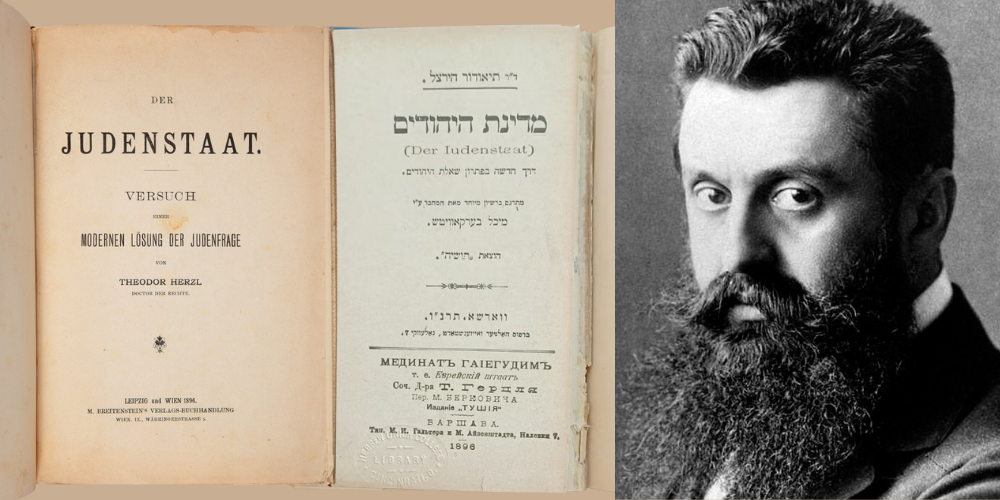
Photos: Theodor Herzl, Der Judenstaat — Wikimedia Commons
On this day, 14 of February 1896, a relatively unassuming pamphlet titled Der Judenstaat (The Jewish State) was published by an Austro-Hungarian journalist named Theodor Herzl. Little did the world know that this slender volume would ignite a movement, fundamentally altering the course of Jewish history, ultimately leading to the re-establishment of the State of Israel.
Herzl's journey to becoming the visionary of modern Zionism was one born of disillusionment and a stark realisation. Initially an advocate for Jewish assimilation into European society, his perspective irrevocably shifted in the face of rampant antisemitism, most acutely during his coverage of the Dreyfus Affair in France. Witnessing Parisian crowds chant "Death to the Jews," Herzl concluded that antisemitism was not a fleeting prejudice but a deeply ingrained, systemic problem that required a political, rather than social, solution. He argued that “The Jewish question exists wherever Jews live in perceptible numbers. Where it does not exist, it is carried by Jews in the course of their migrations. We naturally move to those places where we are not persecuted, and there our presence produces persecution.”
As for the Jewish Question, he continued: “No one can deny the gravity of the Jews' situation. Wherever they live in perceptible numbers, they are more or less persecuted. Their equality before the law, granted by statute, has become practically a dead letter. They are debarred from filling even moderately high positions, either in the army, or in any public or private capacity. And attempts are made to crowd them out of business also. "No dealing with Jews !".”
The "Jewish Question," he posited, demanded a sovereign Jewish state.
His initial blueprint in Der Judenstaat was, in many ways, a masterclass in pragmatism. Herzl meticulously laid out the mechanics of nation-building, proposing two key organisations: "The Society of Jews" for political and diplomatic endeavors, and "The Jewish Company" for the financial and logistical challenges of re-establishing a homeland. Interestingly, the pamphlet even entertained the possibility of establishing this state in Argentina, highlighting Herzl's urgent, almost clinical, drive to find a safe haven for his persecuted people.
However, the pragmatism of Herzl's initial proposal soon encountered the powerful, immovable force of Jewish identity. While Herzl was an astute political observer, he quickly learned that the yearning for a Jewish state was inextricably linked to something far deeper than mere political expediency: the millennia-old connection to the Land of Israel.
Upon engaging with the Jewish masses, particularly those from Eastern Europe who bore the brunt of violent pogroms, Herzl understood that for them, Zionism was not merely about any safe territory; it was inseparable from the biblical Zion. The historical, religious, and cultural gravity of Jerusalem, Judea, and Samaria resonated with a power that no other potential homeland could command. The concept of "return" to their ancestral land provided not only a profound emotional rallying cry but also a potent moral and historical claim on the international stage.
As for previous attempts at a solution to the Jewish Question, Herzl stated: “What is the result of transporting a few thousand Jews to another country? Either they come to grief at once, or prosper, and then their prosperity creates Anti-Semitism.”
This realisation profoundly shaped the nascent Zionist movement. Just a year after Der Judenstaat's publication, Herzl convened the First Zionist Congress in Basel, Switzerland, where the "Basel Program" formally declared the goal of creating "a publicly and legally assured home in Palestine for the Jewish people." The focus had decisively shifted from a pragmatic "state anywhere" to the spiritual and historical imperative of "a state in Zion."
His profound contribution lies in transforming a desperate longing into a concrete political program. He gave voice and structure to an ancient dream, galvanising a scattered people into a unified movement.
Today, as we commemorate the anniversary of Der Judenstaat, we remember not just a political treatise, but the catalyst for a national revival. Herzl’s pamphlet served as the intellectual foundation, but it was the profound and undeniable connection of the Jewish people to their indigenous homeland that ultimately directed the Zionist project towards its destined home: Israel. His words, "If you will it, it is no dream," continue to inspire, reminding us of the enduring power of vision, determination, and the unbreakable bond between a people and their land.
Read Theodor Herzl’s 1986 pamphlet in full here.
Discover Our Newsletter